Sunday, September 15, 2013

The "Beauty" of Death?

Since the passing of my dear friend Ibrahim I haven’t been able to articulate how I really feel, and I can’t write a proper tribute.    

Instead, I will just share a selection of verses from a poem entitled The Beauty of Death by Gibran Khalil Gibran.  When I re-read it three days ago, it reminded me of Ibrahim’s tireless attempts to break my fear of death, and he even asked me to find the beauty within it (I had previously told him that death is one of my fears).

Reading it, I feel that Ibrahim is speaking to us, minus the jokes and pranks of course.

Unfortunately, I can't see or feel the"beauty" of death because all I feel is utter pain, grief, shock, anger and longing.  

I want to tell you Ibrahim that you are wrong, there is nothing beautiful about it. Yet, I also know you are at peace now, and death is only hard for the living. 

So for you, I will try to find the impossible, I will try to internalize these words, but it will surely take many many years. 

The Beauty of Death

Let me sleep, for my soul is intoxicated with love and
Let me rest, for my spirit has had its bounty of days and nights;

Let me rest in the arms of Slumber, for my open eyes are tired;

Dry your tears, my friends, and raise your heads as the flowers
Raise their crowns to greet the dawn.

Come close and bid me farewell; touch my eyes with smiling lips.

I have passed a mountain peak and my soul is soaring in the
Firmament of complete and unbound freedom;
I am far, far away, my companions, and the clouds are
Hiding the hills from my eyes.

I am cloaked in full whiteness;
I am in comfort; I am in peace.

Lament me not, but sing songs of youth and joy; 
Shed not tears upon me, but sing of harvest and the winepress;
Utter no sigh of agony, but draw upon my face with your
Finger the symbol of Love and Joy.

Talk not of my departure with sighs in your hearts; close
Your eyes and you will see me with you forevermore.

Go back to the joy of your dwellings and you will find there
That which Death cannot remove from you and me. 

Wednesday, September 4, 2013

Justice for Hassan and Khaled will show if Yemen has really changed

First published in the National

In the mid 1950s, the famous Adeni poet Lutfi Jaafar Amaan wrote: "In the meadow of impossible, we will plant the happiness and hopes of a generation". Six decades later, his grandson would be shot dead in a killing that diminishes what little hope remains for his generation.

On May 15 this year, Amaan's grandson, Hassan, 20, and his friend Khaled, 21, were shot in cold blood as they attempted to pass a wedding procession.

It is customary to allow a procession to pass without interruption. The young men's innocent defiance of this custom cost them their lives because the procession they passed was linked to a powerful political and tribal figure.

For years, powerful men ­ be they businessmen, politicians, or tribesmen ­robbed citizens of their right to justice and cost thousands their lives. The former president, Ali Abdullah Saleh, allowed influential corrupt men to do as they please with no accountability.

Numerous stories and personal experiences of injustices at the hands of people linked to the government prompted many to participate in the 2011 uprising, demanding justice and the rule of law.

While tribal law provided order and security for communities outside the government eye for hundreds of years, some powerful and corrupt individuals had been given a green light by the government to do as they please.

Many young revolutionaries dreamed of a new Yemen where the law is upheld and all citizens would be treated equally. Hope was placed in the hands of the national unity government and the National Dialogue Conference (NDC).

Yet, for many the case of Hassan and Khaled crushed their faith in the transitional process. "They call this the new Yemen. How is it new when everything is the same?" said Ali, a taxi driver and education ministry employee.

"Corruption is still there, except instead of only one group of people stealing, now you have many."

The person who is accused of killing Hassan and Khaled was identified as a nephew of Sheikh Ali Abd rabbou Al Awadhi, a powerful tribal sheikh, an NDC delegate and high­ranking member of the Islamist Islah party.

This case has been widely publicised. To many, this case resembles the fate of Yemen.

As writer Salah Al Dakkak put it: "It is not simply an act against a citizen, it is an act against citizenship."

Most importantly, it has become the test for the performance of the transitional government.

Three months after Hassan and Khaled died, their killer has not been arrested and a file for the case has not even been officially opened in the Ministry of Interior.

Every day that passes without justice for Hassan and Khaled is a day where the NDC loses its credibility in the eyes of the people.

Sheikh Al Awadhi remains a member of the NDC. At a time when revolutionaries hoped for a complete change in the system and a break from the past's legacy of mass violations, this case has not only enshrined impunity in national law, but also in the psyche of Yemeni citizens.

"Some are demanding my arrest, as if I am the killer, while those who engaged in mass murder enjoy freedom and immunity," said

Sheikh Al Awadhi in a statement he released to media. The immunity law he is referring to was stipulated in the Gulf Cooperation Council's (GCC) transfer of power deal in return for Mr. Saleh's resignation, protecting him and his aides from prosecution for "political crimes" during his rule.

The GCC agreement also requires steps on transitional justice and "measures to ensure that violations of human rights and humanitarian law do not occur in the future". A law on Transitional Justice (TJ) and National Reconciliation has been under discussion since February last year but the cabinet failed to reach consensus on it and the law is currently with President Abd Rabbu Mansour Hadi awaiting approval.

The draft law provides for truth commissions to determine reparations, ranging from material compensation to apologies and memorials. It would also have the authority to compel testimony or the release of documents, and would publish draft reports inviting comments from civil society organisations and the public at large.

These are positive steps that provide some hope but major concerns remain. Will President Hadi and members of the current government, who were part of the old regime, allow for the commission to investigate crimes that occurred while they were officials in the previous government?

According to the lawyer Haykal Bafana: "Transitional Justice is the mirror image of the immunity clause. What the TJ bill requires is an explicit acceptance by the victims of the immunity law that was approved by Yemen's parliament last year."

In effect, victims can seek justice through the TJ law but it will still be subservient to the immunity law and the GCC deal.

Another major question is that of implementation. Too often in countries where the rule of law is ignored, legislation provides decent protection for citizens, but implementation is lacking. Many fear that the transitional justice law will remain ink on paper, never to be implemented.

Despite these negative trends, local community­based initiatives are on the rise. "No one is above the law" flyers that have decorated many cars in major cities around the country. Letters have been delivered to officials through street protests demanding justice for Hassan and Khaled.

The two men's families are vowing to pursue real justice ­ but to do so with words as weapons rather than responding with arms for arms or blood for blood.

Friday, August 16, 2013

Yemen's Independent Youth and Their Role in the National Dialogue Conference- Triggering a Change in Political Culture

Published in SWP Comment

Summary:
In March 2013, a six-month National Dialogue Conference (NDC) began. It has brought together 565 diverse participants, among them representatives of Yemen's independent youth, who were essential in starting the 2011 uprising. The Conference is tasked with putting forward decisions on major topics related to Yemen's future. In July, a majority of participants adopted the decisions and recommendations of six of the nine working groups. Youth and other independent participants were crucial in pushing for recommendations promoting equal citizenship for men and women in the decisions adopted. Yet, their impact on decision making remains limited. In addition, amidst continued insecurity and economic crisis, the working groups on the structure of the state and long-lasting conflicts in the north and south have not reached agreement. While failure of the NDC is thus not unlikely, the participation of independent youth has already triggered positive changes in the country's political culture. Europeans should support this trend and provide technical assistance and skills-building to independent youth groups.

Continue reading here

Tuesday, August 6, 2013

Tuesday, July 16, 2013

The need for Facebook detox

Photo taken from http://theotherpress.ca/an-introduction-to-social-media-detox/


Many people keep asking me why I deactivated Facebook two days ago.  "Is everything ok" they ask? "What happened?"

Nothing happened –per say, but something hit me a couple of days ago.  Like usual, I woke up and turned on my computer and immediately clicked on the small globe on the bottom of the screen and of course opened three tabs: Gmail, Twitter and Facebook.   Sometimes I do that while I’m still in bed.

Once on Facebook, I scrolled down and read the list of status updates, from personal life issues, iftar photos, to mostly, political opinions and smear campaigns.  As usual, I read some negative and sad information about Yemen.  Some of it of course exaggerated.  Rumors fly around Facebook, faster than the time it takes you to load a video on YouTube (if you live in Yemen that is).  A sound of a firecracker in one’s neighborhood becomes “heard bombs near my house today”… “I heard it too” responds another user.  “Can you confirm it?” someone asks “Yes, the shop owner’s cousin who works in the military hospital 5 kilometers away confirmed it”. 

Reading Facebook statuses one assumes that Yemen is doomed and tomorrow we will all wake up to a war.  These rumors of course not only relate to politics, but also to personal life.  People can and have started lots of smear campaigns based on lies and spread it all over Facebook.

Another irritating aspect of Facebook is the “bragging” component. (don’t pretend you don’t know what I’m talking about).  While I believe it’s natural to want to share our successes with friends and family, and to seek their input, it feels like sometimes it's not simply about sharing  accomplishments or even information sharing, but rather it's just to brag.  This becomes so irritating when people don't realize how much work others are doing just but because they do not have the 20th century “bragging” skill for social media or they are not connected online; so their work goes unnoticed.

Worse, is the fact that most of what I read on Facebook these days are hateful comments between people or about other people.  Political differences between groups appear so intense online yet in the national dialogue for example, the same people are more diplomatic with each other.  People feel freer to bash others behind a screen, and while you can get caught up in this political soap opera of who bashed whom and what did they say, it is purely a waste of time and energy.

Another aspect of this is how much you think you are doing by being "politically active online".  Of course there is a lot you can do, but when many activists are on facebook rather than on the ground, something is missing, especially in a country where the majority are illiterate and Internet penetration is about 14.9 percent (up from 5 percent in just one year!).

Of course Facebook has some advantages, such as connecting with family and friends at an instance, and another interesting advantage in the Yemeni context is reading what officials say.  Many high level officials are on facebook, and sometimes what they write on their FB walls becomes official decrees, and sometimes it doesn’t, but you can often assess a lot by what these top officials post.  (Of course this does not apply to one former official who loves to post photos of himself in interesting attire or locations.  This we follow for purely entertainment value).

But the entertainment value seems to be shrinking.  The amount of informational intake is exhausting, as it seeps the energy out of you without even realizing.  The amount of short sentences you read, the links to articles, the videos, and the comments are time consuming as well.  Of course you will say just stop reading everything, but Facebook makes it hard to filter what you read.  You are bombarded with information whether you like it or not.  You wont know how two hours just passed!  I found myself addicted, always checking if I have comments, and pressing that re-fresh button too many times in one hour.  I used to have Internet on my phone and my bill was super high because I was always checking it from there too.  I eventually deactivated Internet from my phone.  
 
But what made me stop is not necessarily the time consuming nature, rather the amount of hate that I have been exposed to, which got me down. I don’t want to be consumed by hate, sadness or bitterness.  Lately it not only sidetracked me from doing my work, but mainly adds to my negative feeling about the current situation in the country.  I’m trying desperately to hold on to hope, and Facebook does not help.  I need positive energy around me. This is why I decided to de-active my account.  Not sure for how long, but the Facebook detox process has to begin.

Months ago, I de-activated my Facebook page and in the amount of time I was away, I was able to finish writing my fist ever play script.  Lets hope this time around I can do something similar, and lets hope this detox process lasts.  

I think I partially wrote this post to make a public commitment, and by so doing, I will think twice before returning to Facebook . So if you find me on FB in the future, do remind me of this post ;)


Saturday, July 13, 2013

Smile


“Everytime you smile at someone, it is an action of love, a gift to that person, a beautiful thing.” - Mother Teresa


Tuesday, July 9, 2013

Ramadan Karim - رمضان كريم

Photos from "the children's festival to welcome Ramadan" in the old city of Sanaa.
 صور من كرنفال الأطفال لإستقبال رمضان في صنعاء القديمة


Thursday, July 4, 2013

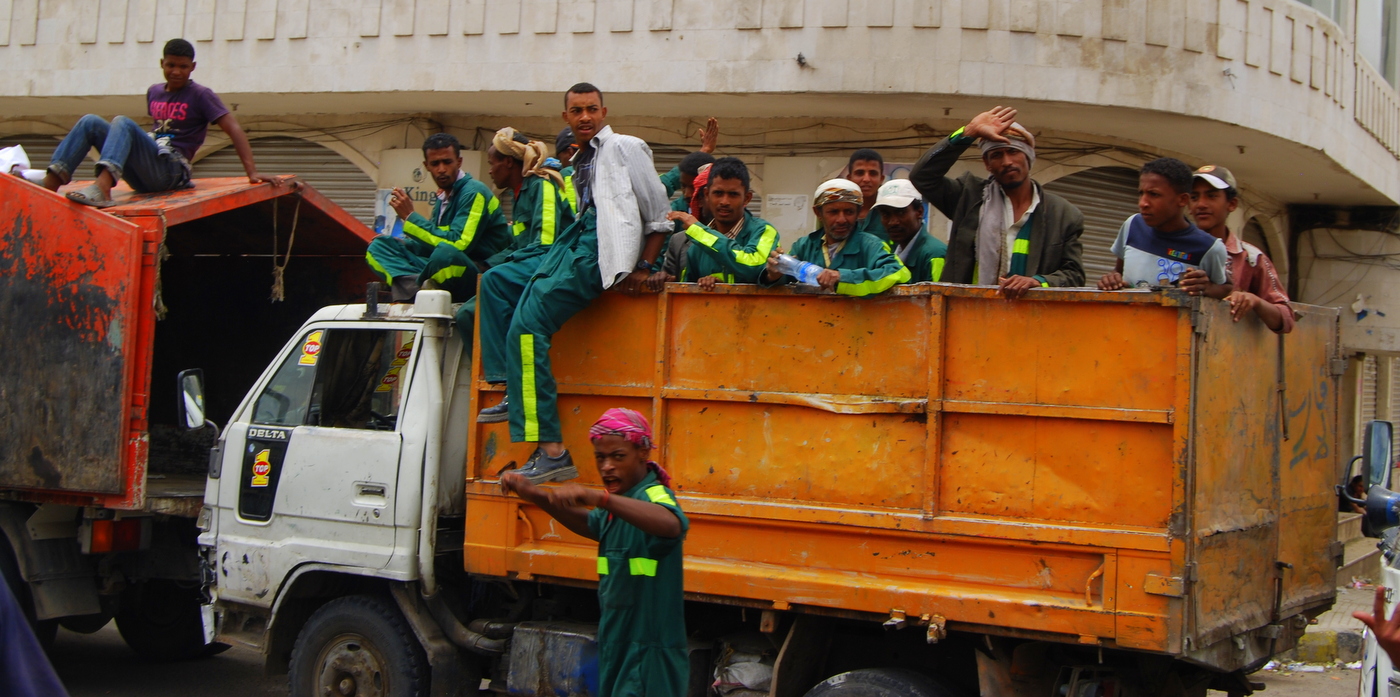
Garbage cleaners in Yemen demand employment

While a government decree was announced in 2012 ordering the full employment of sanitation workers, considering them official state employees, many workers claim that this has not been implemented yet. Garbage collectors are not officially employed by the government, and are only contracted to work per day receiving $3.80 to $4 per day and work 360 days a year, with no vacation days, no holidays, no social or medical insurance, and the years of work do not count towards promotion. A person who worked 18 years gets the same pay as a person who started work yesterday.

On June 24, 2013, the Workers and Housing Union held a protest in front of the President's house demanding implementation of the decree and their other right. Garbage collectors also announced a strike until they are officially employed. 


Monday, June 24, 2013

The Myth of the "Yemen Model"

First published in Huffington Post Blog on May 29 2013.

(This post was written in response to an article by Thomas Friedman in the NYT.  It should not be taken as an analysis of the NDC entirely.  Some of the positives aspects of the NDC have been neglected in this post because it is a response to the overly positive narratives and premature announcements of success of the the NDC which lacked constructive criticism).

Shortly following the internationally funded uncontested election in Yemen, a high-ranking western diplomat berated me for not voting. When I asked him, "would people in your country be happy with a one-person election?" He responded: "people in my country are not trying to kill each other!"
While not all diplomats think this way, unfortunately, that simplistic and ignorant statement is what drives much of western policy on Yemen -- if there is a policy -- and it is also why it is expected that Yemenis should accept half solutions -- should in fact celebrate them!
Maybe misconceptions of Arabs as apolitical, who were just "awakened" by the "Arab Spring," leads to the belief that anything is a step forward. These misconceptions, if internalized, lead to flawed analysis, and worse they can become disastrous policies.

This is egregiously exemplified by Thomas Friedman's recent New York Times op-ed (on May 11) where, for example, he states that "the good news is that -- for now -- a lot of Yemenis really want to give politics a chance." Friedman is referring to the internationally backed National Dialogue Conference (NDC) in Yemen. The NDC began in March 2013 and is to last for six months, with 565 delegates tasked with providing recommendations and culminating in writing of a new constitution. Friedman's statement attempts to celebrate Yemenis, while in fact downplaying an entire history of political participation and ignores Yemen's cultural tradition of dialogue and political pluralism. Yemen has had dialogues before and has operated in a relatively diverse political sphere. The movement for change in 2011 is a culmination of years of activities in the south and north.

Neglecting all of that naturally does not present a thought-out article. While the NDC helped bring new political actors to the forefront creating new social transformations, and while the threat of war has been delayed on the short term; nevertheless, it is too soon to make a grand statement about the success or failure of this process, and definitely too early to announce that the NDC and the overall transitional process is a model to emulate, as Friedman suggests.

Renowned Yemeni journalist Sami Ghaleb critiqued Friedman's piece saying: "Friedman's analysis is the perfect example of the way the US makes premature political assessment on changes in the Arab world. It's the fast food assessment." This fast food assessment is one that ignores long-term impact and also historic factors that influence current reality.

Friedman is not the first to make a grand statement about the NDC. In fact, his piece echoes the statements made by U.S. ambassador to Yemen Gerald M. Feierstein on March 29, 2013 and by Yemen's President later in early May. "Today, we are so close to make a complete success and awaiting the dialogue's results, which will forge the new future of Yemen," said President Hadi during his meeting with UN envoy to Yemen Jamal Benomar.

These statements of success or failure lack depth and fail to define success. For the international community, success might be defined by the fact that a diverse group of Yemenis are in the same room debating (not a first in Yemen, although media likes to propose it as such). For others, success might be defined by the national input in writing a new constitution, or the solving of deep-rooted conflicts in the north and south of the country. This of course, has lead to conflicting ideas on what is expected of the dialogue and hence will most likely lead to disappointment regardless of the output. Ideally, the NDC should be a process to build a new social contract between the people and the governing power centers. Yet, the majority of citizens feel disconnected from this process.

The average person has not felt the impact of the dialogue, and many outside the cities have not even heard about it. If Friedman had spoken to "some of the most interesting journalists, social activists and politicians [he] met in the Arab world" whom he mentioned in his 2010 op-ed, a long list of concerns about the transitional process would have been highlighted.

Just a week before the heavily advertised and financed NDC, I asked a woman in a village near the city of Hodeida "What do you think of the National Dialogue?" A blank stare shaped her face, followed by: "What? What's that?" I proceeded to tell her about the NDC, and then asked her which priorities she hopes would be discussed in the dialogue. "Our stomach," she responded! "We are hungry and we need jobs," she added. She is not the only one who is unfamiliar with the dialogue.
While the recent field visits by members of the NDC to various cities are a positive step, they nevertheless remain closed to certain groups of people. In addition, the attempts so far to engage the general population have failed, partly due to the emphasis on using online medium for marketing in a country where 86 percent of the population do not have access to the internet. The conference location at the expensive and secluded Movenpick hotel with high security adds to the alienation of conference participants from the general society. As lawyer Haykal Bafana said on twitter, "in just over 2 months, Yemen's National Dialogue has spent US$9,282,000 - no tangible benefit so far."
In addition, each NDC participant receives $100 or $180 (for those coming from outside the capital) per day, in a country where 40 percent of the population lives under $2 a day. A participant told me "I don't believe this [NDC] will bring about any change, but I can't find a job either, so why not participate?"

This not only destroys any sense of civic duty but it is also in contrast to the two years of civic engagement felt during the uprising. The wide range of volunteer activities by revolutionaries was an important stop in promoting civic engagement. Yet, the way the NDC is organized is also reminiscent of Saleh's patronage system. It creates what writer Ibrahim Mothana calls, "Per-diocracy" rather than democracy.

These challenges have made the NDC the butt of new nicknames: "the market of illusion", "national sleep hypnosis conference", and "the foreign national dialogue". The role of external players in Yemen is perceived negatively for a number of reasons.

First, the way the international community, and precisely the Group of 10 Ambassadors, have divided tasks related to the transitional process amongst themselves, in their capacity as "facilitators of the GCC Initiative" feels like an imposition to many. For example, the United States is in charge of military restructuring, France the Constitution, the United Kingdom policing, and the United Nations the NDC (with partnership and support from the other countries). This created the perception that the international community is imposing its agenda rather than cooperating or aiding in the transformation.

Second, the transitional process and the NDC are heavily financed by the international community supports the above idea. The Yemen National Dialogue and Constitutional Reform Trust Fund (YNDCRTF) was established to support Yemen's dialogue. The UN program stands at $23.1 million, of which $15.1 million is to finance the Secretariat and conference. In addition, donors from various countries are spending millions on civil society work related to the NDC. The U.S. for instance will spend $10.5 million in coordination with the Secretariat to provide technical and operational assistance to the dialogue offices.

Third, the interference in local decisions by international actors has increased that perception. For example, U.N. envoy Jamal Benomar had the final say in the allocation of representation at the dialogue. In addition, U.S. Ambassador Fierstein's continued press conferences, attendance of NDC and TV announcements on the progress of the transitional process, has made him obtain the title of "Sheikh of Yemen" and has served to enhance the wide held perception that it is an externally lead process with an international rather than an indigenous local agenda.

In addition, many believe that key decisions will be made among Yemen's power centers outside the margins of the dialogue and that this dialogue conference is just an expensive "show" forcing Benomar to announce on May 13 that: "nothing is being cooked outside the conference halls." Nevertheless, a key example of important decisions being taken outside the dialogue is the military restructuring decree, which was announced by President Hadi while the dialogue is ongoing without input from dialogue participants.

Fourth, there is a significant divide between aspirations of the civic movement for change and interests of key foreign and regional players favoring the traditional elite seen through their support for the Gulf Cooperation Council (GCC)'s power transfer agreement, which lead former President Saleh's resignation from power for his vice president in exchange for immunity from prosecution for him and 400 others. The root causes of discontent have not been addressed, which deepens the rift and mistrust in the process.

Last and most important concern, is the inclusiveness of the NDC. While some new entities have in fact been introduced to the political scene, many of the leaders of the Southern Movement boycotted the NDC because they do not believe it will solve the deep grievances felt by the people in the South or their calls for secession. In fact, many of the topics discussed cannot really be negotiated until the other more important issues such as the southern question are dealt with. As Waseem Al-Saqqaf, southern movement activist said:

"NDC members from the Southern Movement are there to discuss the southern issue. Yet, they had to join other working groups such as the one on security and military reform. How can a southerner who believes in the right to self determination or in secession discuss restructuring of a unified army?"
With the majority of southerners outside the negotiation, it is difficult to foresee how the Southern issue can be solved.

In the week Friedman wrote his very optimistic piece, power lines were attacked, a fighter jet crashed in the capital (third one in the past six months), and Yemeni workers in Saudi Arabia were deported. The Yemeni economy is collapsing, people cannot find jobs, electricity cuts are constant in the capital, children are going to sleep hungry, and the same people who ruled the country for the past 33 years are still in power.

These concerns should also be priorities in the national dialogue. For a process to bring about lasting change, the process itself should matter. No matter how "successful" the outputs may be, it should be internally driven one, or else no one will feel ownership of the process, and it will be easy to abandon the results.