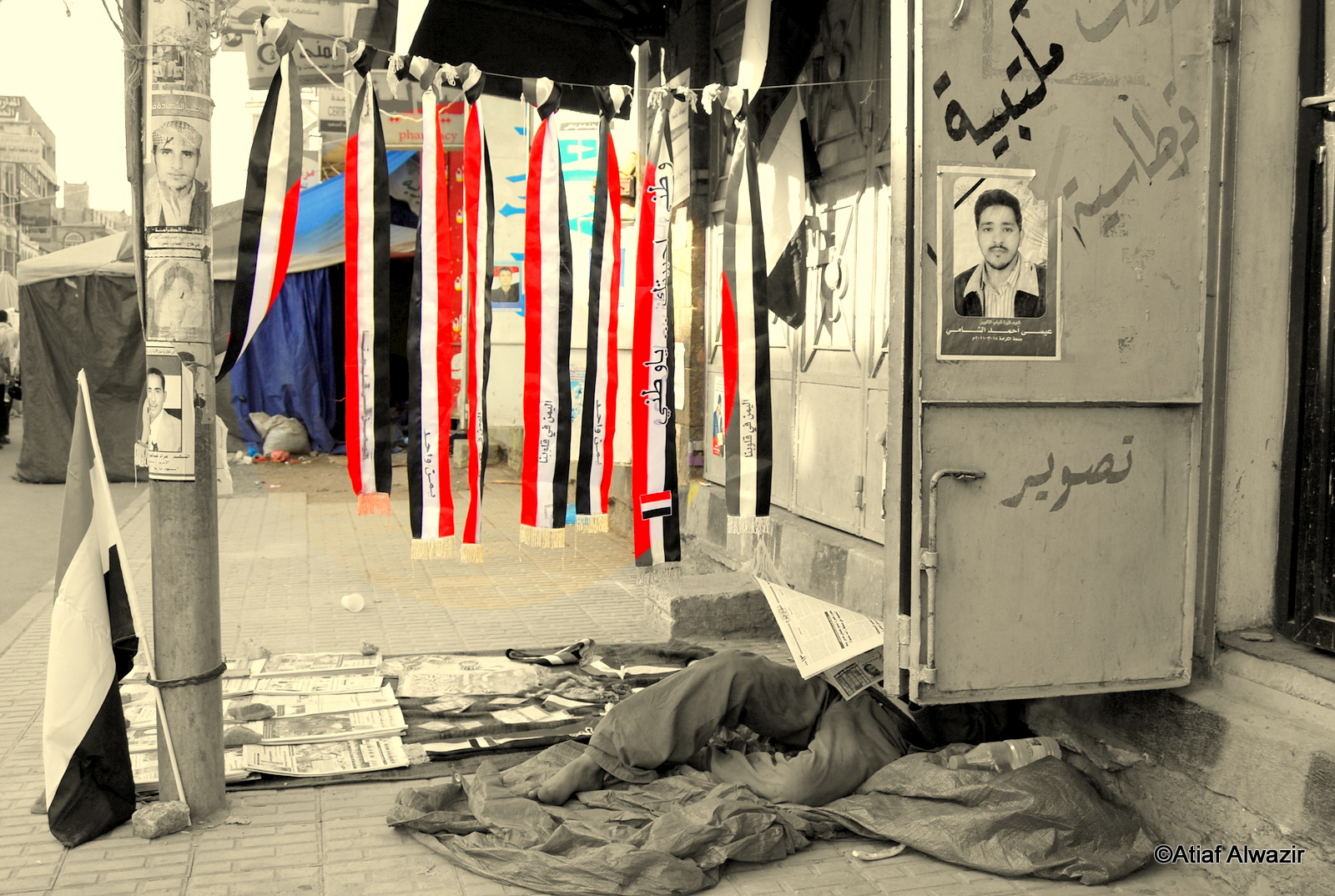
Sunday, May 22, 2011

Unity Day

Saleh often shows off about his success of unifying the country, especially with large military shows on May 22, 2011, the date of unification. Since unity, the actions of the government have done nothing to implement real unity. Stolen lands from Southern people, rampant corruption and unemployment in the South have only served to intensify grievances. Government has been insincere in addressing these grievenes which resulted in a movement to call for separation. While many activists in the North spoke about southern grievances it was not enough to put pressure on the government. People in the South felt alone for what they perceived as the silence of their brothers and sisters against injustice.

This Revolution served to address some of these wounds. Yemenis felt an affinity to "Yemen" like never before. Unity celebrations filled the squares of change. The only thing that jeopardizes unity is Saleh's regime. A new Yemen with justice, equality, and decentralization is the only solution to maintaining unity in Yemen.

Some photos from pro-change unity day celebration in 60 road in Sana'a. To see the full gallery click here


Friday, May 20, 2011

Yemen: tied for 3rd place in the Arab Revolutions


Media Sensation no longer The "Arab Spring" is wonderful and a dream come true. Watching the events unfold in Tunis and Cairo made us all feel part of the revolution. However, by the time Yemen's turn came, another “Arab Revolution” was not as exciting as the first time it appeared on television. Not only is it not as exciting, but we are also competing with a country that has more action to offer its viewers (Libya). Then after that, another country started competing with us over action, death, and arrests (Syria). Viewers world wide quickly forgot about Yemen.

Lessons learned Protesters in Yemen, Tunisia and Egypt turned to each other for advise. Slogans were borrowed, songs, tactics and ideas. Like his people, Saleh also borrowed from his counterparts. The Yemeni government repeated some of the same tactics used in Egypt and Libya of baltagya or hired thugs, defaming protesters, and inciting the role of al-Qaeda. However, Yemeni government had time to learn from the mistakes of the other leaders. For example, instead of completely shutting down internet, the Yemeni government just slows it down with frequent on-and-off cuts, this way no one is blamed for “censorship”.

Of course, President Saleh watched or was at least informed about air strikes on Libya which most likely mellowed the Qadhafi potential response in Yemen. However, President Saleh also watched Mubarak and his family being tried, which surely made Saleh hold on to power even more, and negotiate for his immunity, which most protesters rightly do not accept. Hence, creating a deadlock. How could he leave when he watched what happened to the others? But how can the people agree for immunity after all that has happened?

It's taking too long Because we watched the Tunisian and Egyptian example, Yemenis feel that our revolution is taking too long. “Three months compared to 18 days” is a common complaint heard at the square. We need to remind ourselves that peaceful revolutions normally take much longer than 18 days and that the Egyptians and Tunisians are still struggling to this day.
Gandhi's independence movement lasted 30 years from 1915 – 1947 and the People Power Revolution in the Philippines which ousted President Marcos lasted three years from 1983 to 1986. So lets put things in perspective in order to be happy about what we have accomplished so far.

Guerrilla Journalism

This clip by Yemeni film maker Sarah Ishaq gives an idea about the role of citizen journalists in the Yemeni Revolution. Many Yemenis feel responsible to spread information about the Revolution to the world, a feeling that has turned many into citizen journalists.

Thursday, May 19, 2011

While Yemen's President Holds On, Youth Activists Plan Their Next Steps on Facebook

This Q & A was published on Movements.org

It has been three months since youth took to the streets in Yemen. As President Saleh goes back and forth about whether or not to accept a deal for a brokered resignation of power, camps in city centers throughout the country show no sign of dissolving.

While they wait - and continue to protest - what are Yemen's pro-democracy youth activists up to? As the Yemeni based activist Atiaf Alwazir describes in this Q & A, they are making heavy use of Facebook groups to form plans for what will come next and to organize one another so that, if the time comes, they can most effectively put those plans into place.

Atiaf was born in Sana but left when she was 1 years old. Her family lived in various places before settling in the U.S., and she recently returned to Yemen in order to get involved in the pro-democracy and human rights activism there. She runs the blog Woman From Yemen.

Q: What compelled you to become an activist in the first place?

A: Many reasons. One is that as an NGO worker i've dealt directly with social, economic, and political problems that face Yemen for many years. Anyone working in development will quickly realize that the root cause of Yemen's poverty is the corrupt government. Second, human rights violations were so rampant in Yemen, and this is something I have always been outspoken about. Third, my family background: my father is a historian who has written extensively about Yemen, and my uncles as well. Due to their outspoken nature, they had to live abroad. Growing up in that environment influenced me. I felt that i was lucky to get the education i got in the US, and that i had a duty and responsibility to give back to Yemen.

Q: Only 2% of the population in Yemen has internet access. How has information about protests spread through Yemen?

A: In many major cities there are "sit-in" sites that have turned into "mini cities" for the protesters. The areas have tents, vendors, and seminars. People are camped there and have been there for three months. So decisions to march are spread via the stage at the sit-in site, and mainly via SMS and Facebook.

Between cities, protesters are trying to coordinate using phone calls, Facebook, and SMS messages. For example deciding what to name a Friday (every Friday has a name) many groups chat to discuss it from different cities to try to unify the name nationwide. Sometimes one city decides and others follow.

Yes, only 2% of the population has internet access, but the majority of young activists find ways to get online. As an example, it's now 1 AM and practically everyone I know is on Facebook. i'm part of at least 14 Yemeni groups, discussing the revolution, organizing, suggesting ideas. These groups all have around 1000 members - not many compared to the number of people in the street, but many of them are leaders and activists. There are different groups - one is called the group for coordination, where people can share ideas on how to run things and what to do next. One is for creating and finalizing the "youth demands" document (now that it's finalized group is not as active). One is a women's revolutionary group talking about women's issues (the role of women in the revolution, and how to guarantee women's rights post revolution), then others are groups associated with specific movements or youth coalitions discussing activities related to them at specific city squares.

The role of media is very important in this revolution, like the other revolutions it was inspired by, to make people aware and help in coordination.

Q: If Saleh were to give in to youth protesters' demands tomorrow, what would you want to happen? Who would lead?

A: The demands are quite extensive and detailed - it includes the fact that a transitional government should lead the country. and they should not be part of the former regime. and that later fair elections should be held after electoral commission is changed & electoral law amended. This was signed by over 150 groups and coalitions in the squares around the country

Q: Have youth activists learned from the lessons of Tunisians and Egyptians when it comes to planning for the transition?

A: We here are watching that closely...and I think because we have more time here, on the one hand it's taking too long, but on the other hand it's giving people the time to network and organize more than in Cairo and Tunis. It's clear to many of us, that the revolution is ongoing even after Saleh leaves the post-revolution will be the longer and harder struggle

That's why in some of the group's mission it says that they will be working during and after the revolution, in order to protect the revoultion from being hijacked...and to make sure that demands are met.

Tuesday, May 17, 2011

Creativity of Yemenis at the square

This tent is made up of empty red, white, and black bottles forming a Yemeni flag. This idea should be exported to the West as a new form of recycling, don't you think?

Inside the Yemeni flag tent


Why are you monitoring us?

This post is directed to specific people I know who spend so much of their time monitoring activities and reporting back to security apparatus in Yemen. Although I completely disagree with what they do, I must say, I admire their determination and hard work, especially these days when so many people are vocal about their opinions.


Yes, I'm talking about you

I know you are reading this

I know you are forwarding this

I know you are paid to watch me

I know you are paid to catch me


I see that change is necessary

You see change as destructive

You think I'm naive

I think you are selfish

I want equal rights

For you its all about what the sheikh likes


In the mirror what do you see?

will your children find your name amongst the heroes of history?

Or amongst those who supported tyranny?


I often wonder why you choose to do this?

I don't know if it's for fame, money, or glory

Or is it really an ideology?


Like every opinion, this one too will have two sides

And we are both spokesmen for our side


I now see that while you are against me

You may not be against our country

I wish you could see the same in me

Because in the end, we are both Yemeni.

Monday, May 16, 2011

My love oh Yemen Song

Yemeni Talent is rising & youth are expressing their emotions and feelings towards the Revolution through various means. My love oh Yemen is one of the latest revolutionary songs by Watany Initiative.
Song writer & Singer: Ahmed Khalid
Lyrics: Majid al-Jabry

Align Center


Friday, May 13, 2011

Photos: Friday May 13, 2011

On Friday May 13, 2011 pro-government and pro-change protesters went to the streets in the usual Friday show of loyalties. The pro-change protesters called this Friday, Friday of Decisiveness and loyalty to Sa'ada. Hundreds of thousands of pro-change supporters gathered in 60 street to perform Friday prayers.


Wednesday, May 11, 2011

May 11 attack on peaceful protesters in Sanaa

Bullet sacket, May 11, 2011

Today at 4:00 pm, led by some prominent activists, a group of youth decided to march. It wasn't a majority decision but nevertheless they marched from 20 street to Kuwait street with the intention to head to prime minister's office and hold a sit-in there. Around 5:30 p.m. near the “Blood Bank” on a side street off zira'a street, they were attacked by men dressed in military uniforms (who they really are is still a subject of discussion) with heavy gun fire and tear gas. Firing continued off and on until around 11 p.m. Sometimes it was very heavy and continuous gun shots, sometimes it was sporadic. So far, according to medics at field hospital & media committee 9 confirmed deaths, 10 in critical condition, 286 wounded by gun shots, and 300 wounded by tear gas. The death toll will likely increase.

To view the photo gallery with more photos of today click here.


Photos of May 10, before, during, and after the march

On March 10, protesters went on a short march around the square. My gallery on posterous shows events before, during, and after the march. For a glimpse of what's in the gallery, here are two photos.

Before the march

man reading under Yemeni flags

During the march
protester asks, where is the diesel?