Tuesday, July 16, 2013

The need for Facebook detox

Photo taken from http://theotherpress.ca/an-introduction-to-social-media-detox/


Many people keep asking me why I deactivated Facebook two days ago.  "Is everything ok" they ask? "What happened?"

Nothing happened –per say, but something hit me a couple of days ago.  Like usual, I woke up and turned on my computer and immediately clicked on the small globe on the bottom of the screen and of course opened three tabs: Gmail, Twitter and Facebook.   Sometimes I do that while I’m still in bed.

Once on Facebook, I scrolled down and read the list of status updates, from personal life issues, iftar photos, to mostly, political opinions and smear campaigns.  As usual, I read some negative and sad information about Yemen.  Some of it of course exaggerated.  Rumors fly around Facebook, faster than the time it takes you to load a video on YouTube (if you live in Yemen that is).  A sound of a firecracker in one’s neighborhood becomes “heard bombs near my house today”… “I heard it too” responds another user.  “Can you confirm it?” someone asks “Yes, the shop owner’s cousin who works in the military hospital 5 kilometers away confirmed it”. 

Reading Facebook statuses one assumes that Yemen is doomed and tomorrow we will all wake up to a war.  These rumors of course not only relate to politics, but also to personal life.  People can and have started lots of smear campaigns based on lies and spread it all over Facebook.

Another irritating aspect of Facebook is the “bragging” component. (don’t pretend you don’t know what I’m talking about).  While I believe it’s natural to want to share our successes with friends and family, and to seek their input, it feels like sometimes it's not simply about sharing  accomplishments or even information sharing, but rather it's just to brag.  This becomes so irritating when people don't realize how much work others are doing just but because they do not have the 20th century “bragging” skill for social media or they are not connected online; so their work goes unnoticed.

Worse, is the fact that most of what I read on Facebook these days are hateful comments between people or about other people.  Political differences between groups appear so intense online yet in the national dialogue for example, the same people are more diplomatic with each other.  People feel freer to bash others behind a screen, and while you can get caught up in this political soap opera of who bashed whom and what did they say, it is purely a waste of time and energy.

Another aspect of this is how much you think you are doing by being "politically active online".  Of course there is a lot you can do, but when many activists are on facebook rather than on the ground, something is missing, especially in a country where the majority are illiterate and Internet penetration is about 14.9 percent (up from 5 percent in just one year!).

Of course Facebook has some advantages, such as connecting with family and friends at an instance, and another interesting advantage in the Yemeni context is reading what officials say.  Many high level officials are on facebook, and sometimes what they write on their FB walls becomes official decrees, and sometimes it doesn’t, but you can often assess a lot by what these top officials post.  (Of course this does not apply to one former official who loves to post photos of himself in interesting attire or locations.  This we follow for purely entertainment value).

But the entertainment value seems to be shrinking.  The amount of informational intake is exhausting, as it seeps the energy out of you without even realizing.  The amount of short sentences you read, the links to articles, the videos, and the comments are time consuming as well.  Of course you will say just stop reading everything, but Facebook makes it hard to filter what you read.  You are bombarded with information whether you like it or not.  You wont know how two hours just passed!  I found myself addicted, always checking if I have comments, and pressing that re-fresh button too many times in one hour.  I used to have Internet on my phone and my bill was super high because I was always checking it from there too.  I eventually deactivated Internet from my phone.  
 
But what made me stop is not necessarily the time consuming nature, rather the amount of hate that I have been exposed to, which got me down. I don’t want to be consumed by hate, sadness or bitterness.  Lately it not only sidetracked me from doing my work, but mainly adds to my negative feeling about the current situation in the country.  I’m trying desperately to hold on to hope, and Facebook does not help.  I need positive energy around me. This is why I decided to de-active my account.  Not sure for how long, but the Facebook detox process has to begin.

Months ago, I de-activated my Facebook page and in the amount of time I was away, I was able to finish writing my fist ever play script.  Lets hope this time around I can do something similar, and lets hope this detox process lasts.  

I think I partially wrote this post to make a public commitment, and by so doing, I will think twice before returning to Facebook . So if you find me on FB in the future, do remind me of this post ;)


Saturday, July 13, 2013

Smile


“Everytime you smile at someone, it is an action of love, a gift to that person, a beautiful thing.” - Mother Teresa


Tuesday, July 9, 2013

Ramadan Karim - رمضان كريم

Photos from "the children's festival to welcome Ramadan" in the old city of Sanaa.
 صور من كرنفال الأطفال لإستقبال رمضان في صنعاء القديمة


Thursday, July 4, 2013

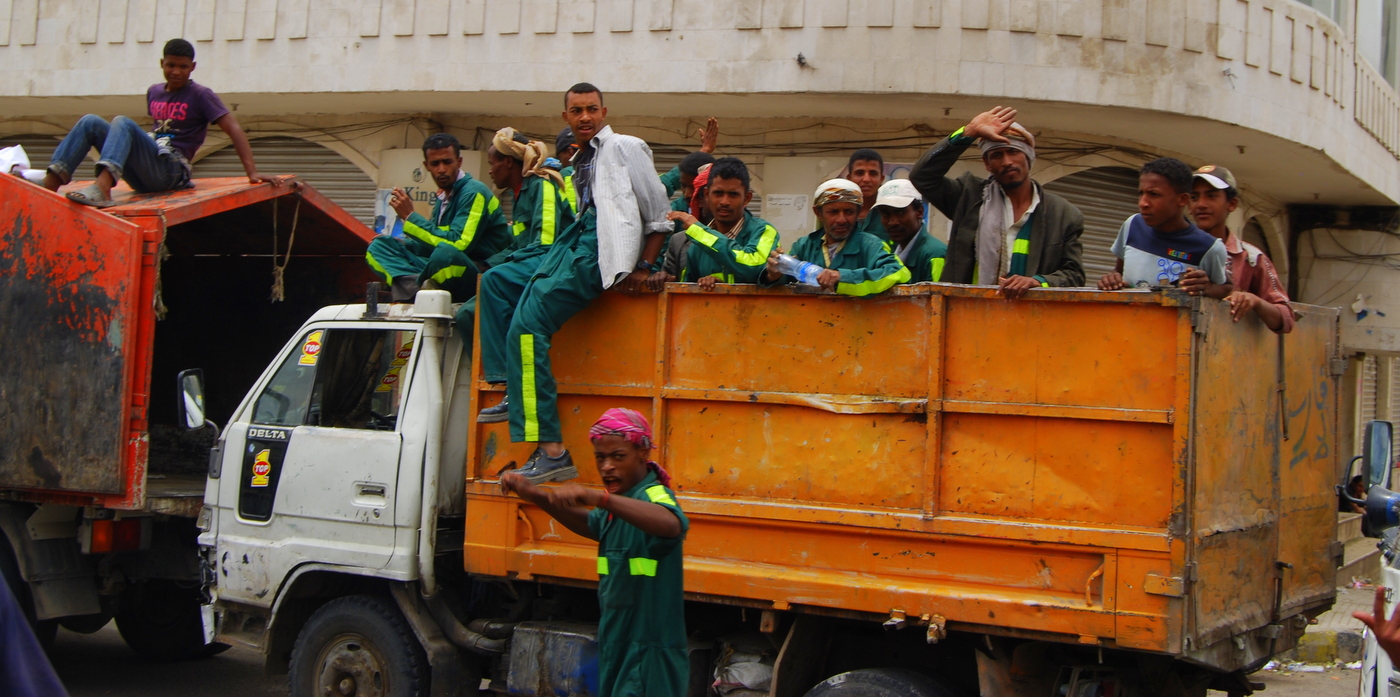
Garbage cleaners in Yemen demand employment

While a government decree was announced in 2012 ordering the full employment of sanitation workers, considering them official state employees, many workers claim that this has not been implemented yet. Garbage collectors are not officially employed by the government, and are only contracted to work per day receiving $3.80 to $4 per day and work 360 days a year, with no vacation days, no holidays, no social or medical insurance, and the years of work do not count towards promotion. A person who worked 18 years gets the same pay as a person who started work yesterday.

On June 24, 2013, the Workers and Housing Union held a protest in front of the President's house demanding implementation of the decree and their other right. Garbage collectors also announced a strike until they are officially employed


Monday, June 24, 2013

The Myth of the "Yemen Model"

First published in Huffington Post Blog on May 29 2013.

(This post was written in response to an article by Thomas Friedman in the NYT.  It should not be taken as an analysis of the NDC entirely.  Some of the positives aspects of the NDC have been neglected in this post because it is a response to the overly positive narratives and premature announcements of success of the the NDC which lacked constructive criticism).

Shortly following the internationally funded uncontested election in Yemen, a high-ranking western diplomat berated me for not voting. When I asked him, "would people in your country be happy with a one-person election?" He responded: "people in my country are not trying to kill each other!"
While not all diplomats think this way, unfortunately, that simplistic and ignorant statement is what drives much of western policy on Yemen -- if there is a policy -- and it is also why it is expected that Yemenis should accept half solutions -- should in fact celebrate them!
Maybe misconceptions of Arabs as apolitical, who were just "awakened" by the "Arab Spring," leads to the belief that anything is a step forward. These misconceptions, if internalized, lead to flawed analysis, and worse they can become disastrous policies.

This is egregiously exemplified by Thomas Friedman's recent New York Times op-ed (on May 11) where, for example, he states that "the good news is that -- for now -- a lot of Yemenis really want to give politics a chance." Friedman is referring to the internationally backed National Dialogue Conference (NDC) in Yemen. The NDC began in March 2013 and is to last for six months, with 565 delegates tasked with providing recommendations and culminating in writing of a new constitution. Friedman's statement attempts to celebrate Yemenis, while in fact downplaying an entire history of political participation and ignores Yemen's cultural tradition of dialogue and political pluralism. Yemen has had dialogues before and has operated in a relatively diverse political sphere. The movement for change in 2011 is a culmination of years of activities in the south and north.

Neglecting all of that naturally does not present a thought-out article. While the NDC helped bring new political actors to the forefront creating new social transformations, and while the threat of war has been delayed on the short term; nevertheless, it is too soon to make a grand statement about the success or failure of this process, and definitely too early to announce that the NDC and the overall transitional process is a model to emulate, as Friedman suggests.

Renowned Yemeni journalist Sami Ghaleb critiqued Friedman's piece saying: "Friedman's analysis is the perfect example of the way the US makes premature political assessment on changes in the Arab world. It's the fast food assessment." This fast food assessment is one that ignores long-term impact and also historic factors that influence current reality.

Friedman is not the first to make a grand statement about the NDC. In fact, his piece echoes the statements made by U.S. ambassador to Yemen Gerald M. Feierstein on March 29, 2013 and by Yemen's President later in early May. "Today, we are so close to make a complete success and awaiting the dialogue's results, which will forge the new future of Yemen," said President Hadi during his meeting with UN envoy to Yemen Jamal Benomar.

These statements of success or failure lack depth and fail to define success. For the international community, success might be defined by the fact that a diverse group of Yemenis are in the same room debating (not a first in Yemen, although media likes to propose it as such). For others, success might be defined by the national input in writing a new constitution, or the solving of deep-rooted conflicts in the north and south of the country. This of course, has lead to conflicting ideas on what is expected of the dialogue and hence will most likely lead to disappointment regardless of the output. Ideally, the NDC should be a process to build a new social contract between the people and the governing power centers. Yet, the majority of citizens feel disconnected from this process.

The average person has not felt the impact of the dialogue, and many outside the cities have not even heard about it. If Friedman had spoken to "some of the most interesting journalists, social activists and politicians [he] met in the Arab world" whom he mentioned in his 2010 op-ed, a long list of concerns about the transitional process would have been highlighted.

Just a week before the heavily advertised and financed NDC, I asked a woman in a village near the city of Hodeida "What do you think of the National Dialogue?" A blank stare shaped her face, followed by: "What? What's that?" I proceeded to tell her about the NDC, and then asked her which priorities she hopes would be discussed in the dialogue. "Our stomach," she responded! "We are hungry and we need jobs," she added. She is not the only one who is unfamiliar with the dialogue.
While the recent field visits by members of the NDC to various cities are a positive step, they nevertheless remain closed to certain groups of people. In addition, the attempts so far to engage the general population have failed, partly due to the emphasis on using online medium for marketing in a country where 86 percent of the population do not have access to the internet. The conference location at the expensive and secluded Movenpick hotel with high security adds to the alienation of conference participants from the general society. As lawyer Haykal Bafana said on twitter, "in just over 2 months, Yemen's National Dialogue has spent US$9,282,000 - no tangible benefit so far."
In addition, each NDC participant receives $100 or $180 (for those coming from outside the capital) per day, in a country where 40 percent of the population lives under $2 a day. A participant told me "I don't believe this [NDC] will bring about any change, but I can't find a job either, so why not participate?"

This not only destroys any sense of civic duty but it is also in contrast to the two years of civic engagement felt during the uprising. The wide range of volunteer activities by revolutionaries was an important stop in promoting civic engagement. Yet, the way the NDC is organized is also reminiscent of Saleh's patronage system. It creates what writer Ibrahim Mothana calls, "Per-diocracy" rather than democracy.

These challenges have made the NDC the butt of new nicknames: "the market of illusion", "national sleep hypnosis conference", and "the foreign national dialogue". The role of external players in Yemen is perceived negatively for a number of reasons.

First, the way the international community, and precisely the Group of 10 Ambassadors, have divided tasks related to the transitional process amongst themselves, in their capacity as "facilitators of the GCC Initiative" feels like an imposition to many. For example, the United States is in charge of military restructuring, France the Constitution, the United Kingdom policing, and the United Nations the NDC (with partnership and support from the other countries). This created the perception that the international community is imposing its agenda rather than cooperating or aiding in the transformation.

Second, the transitional process and the NDC are heavily financed by the international community supports the above idea. The Yemen National Dialogue and Constitutional Reform Trust Fund (YNDCRTF) was established to support Yemen's dialogue. The UN program stands at $23.1 million, of which $15.1 million is to finance the Secretariat and conference. In addition, donors from various countries are spending millions on civil society work related to the NDC. The U.S. for instance will spend $10.5 million in coordination with the Secretariat to provide technical and operational assistance to the dialogue offices.

Third, the interference in local decisions by international actors has increased that perception. For example, U.N. envoy Jamal Benomar had the final say in the allocation of representation at the dialogue. In addition, U.S. Ambassador Fierstein's continued press conferences, attendance of NDC and TV announcements on the progress of the transitional process, has made him obtain the title of "Sheikh of Yemen" and has served to enhance the wide held perception that it is an externally lead process with an international rather than an indigenous local agenda.

In addition, many believe that key decisions will be made among Yemen's power centers outside the margins of the dialogue and that this dialogue conference is just an expensive "show" forcing Benomar to announce on May 13 that: "nothing is being cooked outside the conference halls." Nevertheless, a key example of important decisions being taken outside the dialogue is the military restructuring decree, which was announced by President Hadi while the dialogue is ongoing without input from dialogue participants.

Fourth, there is a significant divide between aspirations of the civic movement for change and interests of key foreign and regional players favoring the traditional elite seen through their support for the Gulf Cooperation Council (GCC)'s power transfer agreement, which lead former President Saleh's resignation from power for his vice president in exchange for immunity from prosecution for him and 400 others. The root causes of discontent have not been addressed, which deepens the rift and mistrust in the process.

Last and most important concern, is the inclusiveness of the NDC. While some new entities have in fact been introduced to the political scene, many of the leaders of the Southern Movement boycotted the NDC because they do not believe it will solve the deep grievances felt by the people in the South or their calls for secession. In fact, many of the topics discussed cannot really be negotiated until the other more important issues such as the southern question are dealt with. As Waseem Al-Saqqaf, southern movement activist said:

"NDC members from the Southern Movement are there to discuss the southern issue. Yet, they had to join other working groups such as the one on security and military reform. How can a southerner who believes in the right to self determination or in secession discuss restructuring of a unified army?"
With the majority of southerners outside the negotiation, it is difficult to foresee how the Southern issue can be solved.

In the week Friedman wrote his very optimistic piece, power lines were attacked, a fighter jet crashed in the capital (third one in the past six months), and Yemeni workers in Saudi Arabia were deported. The Yemeni economy is collapsing, people cannot find jobs, electricity cuts are constant in the capital, children are going to sleep hungry, and the same people who ruled the country for the past 33 years are still in power.

These concerns should also be priorities in the national dialogue. For a process to bring about lasting change, the process itself should matter. No matter how "successful" the outputs may be, it should be internally driven one, or else no one will feel ownership of the process, and it will be easy to abandon the results.

Saturday, May 18, 2013

Updated: No one should be above the law!


On Wednesday May 15, twenty-two year old Khalid Al-Khateeb flew from Aden to Sana'a for an interview hoping for a potential scholarship to study in Germany*.  That night,  he and his  20-year old friend Hassan Aman went out. Little did they know that this car ride would be their last.

Around 10 pm., while they were in the car, they came across a wedding procession on 50 street in Beit Boss area.  Then, according to their families, as they were trying to bypass the procession - and here details are still fuzzy - armed men got out of a car and shot them in front of police cars who were there to "protect" the wedding procession. 


The car and the armed men are reportedly linked to Al-Awadhi tribe, and more precisely to its Sheikh Ali Abd Rabo Al-Awadhi, a National Dialogue participant in the southern issue working group.  

The criminal investigation has gathered evidence and forensic reports have been conducted but not published yet, and details are still yet to be revealed.  The ministry of interior announced the plate number of the car, and stated that the motives of the killing is not yet clear and that they are still searching for the killers.

As this cartoon illustrates**, for many Yemenis, the motive is clear: those with weapons flexing their muscles and taking advantage of their power.  

Man says "There is nothing here sir, they are just some youth that the Sheikh killed... no no thank God, the Sheikh is ok"

This brutal show of force with disregard for humanity and no care for potential consequences has shocked the capital, and of course the family.   Since she heard the news, Hassan's mother has lost the ability to speak.

 The case is slowly becoming a national issue and shaping public opinion on the matter. This might be partially due to the fact that Hassan Aman is the grandson of the famous poet Lutfi Jafar Aman, but more importantly because various groups have together taken this issue as a priority.  


Today, majority of participants at the National Dialogue Conference froze their membership demanding the arrest and investigation of perpetrators.  In addition, a protest was also held in front of Parliament demanding justice.  Another protest is scheduled to take place on Monday.

Poster at rally demanding justice reads "We demand arrest of the murders of Hassan Aman and Khalid Al-Khateeb"

Online campaigns have also been dedicated to this issue.  R.I.P Hassan Aman & Khalid Al-Khateeb page has been setup to draw attention to this case.  

This case of course is unfortunately not the first of its kind.  Just a year ago, the body guard of the Prime Minister's daughter killed a guard at the English language institute Exceed.  This video taken by the Institute's camera shows the incident.   

According to local media, the Prime Minister ordered the surrender of the body guard and the case was handled by ministry of interior.  Since then, there has been conflicting information about what happened afterwards with the case.

There are hundreds of other stories throughout the country that do not make it to the the media, mainstream or alternative.  Not only about murder, but also illegal detention, land grabbing, and forced marriages.  These highlight the brutality of corruption and power in the absence of accountability and rule of law.

The issue should not be looked at as simply a problem with the "tribal" structure, because there are positives and negatives when it comes to the tribal structure.  For example, through tribal law, tribes have for a long time provided stability and security in areas far removed from governing structures.  

The main issue here is the ease at which corrupt powerful men, tribesman or others, can kill and steal, and get away with it. No one should be above the law, not a powerful tribesman, nor a rich businessman, nor a government official.  Sooner or later justice will prevail.
 
"We will not respond arms for arms, or blood for blood ...our weapon is the power of words" said Mohammed Aman on Facebook in response to the murder of his cousin.  

So lets spread his words by demanding Justice and equality, after all isn't that what the revolution and the calls for a civic state were all about?


campaign poster says "Stay silent today...tomorrow you will be the victim" - photos of the two martyrs Hassan and Khalid

==
* This post has been updated, earlier I wrote that he flew from Aden to Sanaa in order to fly to Germany, but it was revealed that he had an interview that day for a potential scholarship to  Germany.

** Cartoon was added two hours after initial post.


Sunday, May 12, 2013

التعليم حق أساسي وليس رفاهية!

بالأمس عندما كنت عائدة إلى المنزل على المترو في برلين، كانت هناك امرأة عجوز، جالسة أمامي و كأنها النسخة الألمانيّة لجدتي اليمنية. عيونها المليئة بالدفيء والعاطفة تتناقض مع الأسلوب الجاف التي كانت تعطيه للشخص الجالس بجانبها ربما كان ذلك بسبب قربه الشديد منها. شفتيها تشير إلى عدم الراحة، بنفس الطريقة التي تحرك جدتي شفتيها عندما تكون منزعجة. كدت على وشك أن أضحك بصوت عالٍ مبتهجه بما أرى أمامي وأردت أن أقوم وأعانقها حالا. لكني نظرت إليها فوجدتها مستغرقة في القراءة. 

نعم إنها تقرأ!

في حين يعتبر هذا عمل طبيعي جدا هنا ، إلا انه في اليمن لا يوجد مثل هذا الإقبال على المطالعة لأسباب عدة منها أن ٦٠ في المئة من النساء أميّات، ولذلك تعتبر القارئة شيء نادر و مميّز.

ثم خطر في ذهني ذلك اليوم الذي كانت جدتي مريضة في المستشفى، وكانت الأسرة مجتمعة حولها. في ذلك اليوم خرجت لشراء ماء للزوّار، ووجدت مجلة فيها مقال عن المسلسل التركي الذي تتابعه جدتي، فاشتريت المجلّة وفي بالي ان المقال سيعجبها، وسيساعدها على تمشية الوقت في المستشفى.

عندما عدت إلى المستشفى أعطيتها المجلة، وقالت لي: "شكرا لك، هناك العديد من الصور الجميلة في هذه المجلة". وفي تلك اللحظة تذكرت أن جدتي لا تستطيع القراءة. بالطبع كنت أعرف أنها لا تقرأ، ولكن لم أستشعر هذه المعلومة حتى تلك اللحظة.

أدركت أيضا شيئا آخر: وجود تحوّل في عائلتي. جدتي ، لا تستطيع القراءة أو الكتابة، ووالدتي تخرجت من الثانوية، وأنا لدي درجة الماجستير. هذا بالفعل شهادة للتغيرات التدريجية التي حدثت وتحدث في مجتمعنا بشكل بسيط وبدون توسع افقي، ولكن هناك للأسف الكثيرات اللاتي لم تكن لديهن هذه الفرصة.

هناك الآلاف من النساء الشابات اللاتي يصادفن مشاكل كثيرة، لا تقتصر على عدم معرفتهن بفتح الفيسبوك أو تويتر فحسب وإنما لانهن لا يعرفن للقراءة أو الكتابة.


منذ وقت طويل لم يكن المجال الدراسي مفتوحا أمام النساء، وفي العهد الجمهوري تركز التعليم على المدن الكبيرة، أما في الأرياف فقد منعتهن عن الدراسة عدة أسباب؛ إما بسبب عدم وجود مدرسة في قريتهم، أو لأن المدرسة بعيدة جدا، أو لأنهن اضطررن إلى العمل لمساعدة الأسرة، أو لأنهن تزوجن صغيرات، أو لأن الدولة لم تطبق قانون إلزامية التعليم ولم توفر المدارس بالشكل المطلوب.


اليوم، العديد يتحدث عن أهمية المشاركة السياسية للمرأة، وهذا مهم جدا، وضروري جدا، ولكن يتعين علينا ألا نتجاهل الحاجة الماسة إلى الرعاية الصحية الكاملة، والتعليم الكافي للنساء. للأسف كثير من الحركات النسائية تركز فقط على الحقوق السياسية، وتتجاهل الحقوق الأساسية، وبذلك، فإنها تتجاهل الجزء الأكبر من احتياجات المجتمع النسوي.


أتذكر عندما كنت في زيارة لقرية بالقرب من العاصمة التقيت بشاب في السادس من عمره، في غاية الذكاء، تحدثنا لبعض الوقت ودعاني للقاء والدته، أخذني إلى منزلهم، وعندما دخلت، لاحظت أن الأم لديها طفل مريض ممدد بجانبها.


عندما رأتني، سألتني، "هل تعرفي تقرئين؟" قلت لها: نعم. قالت: "زوجي اشترى هذا الدواء، ولكن أنا لا أعرف كيف أعطيه لطفلي." أخذت العلبة وقرأت لها التعليمات بصوت عال . وجودي هناك كانت صدفة إلهية ولكن ماذا عن العديد من الأوقات عندما لا يوجد أحد للمساعدة؟.


عندما كنا في ساحة التغيير، بدأت بعض النساء دورة لمحو الأمية في إحدى الخيام،.وكانت تلك مبادرة رائعة، وكانت هذه فرصة مذهلة للمرأة للمشاركة والتعلم ولبناء مشاركة مجتمعيّة حقيقيّة.


دعونا جميعا نعمل معا للمطالبة من الحكومة إعادة برنامج فصول محو الأمية التي كانت تطبق في السابق، ودعونا أيضا نطالب بالتعليم والرعاية الصحية للنساء وأن تكون هذه المطالب من الأولويّات السياسيّة في مؤتمر الحوار الوطني

Reading should be a right not a privilege

Yesterday when I was riding Berlin's metro to return home, an old woman was sitting in front of me.  She reminded me so much of my grandmother.  She was the German clone of Mama Sayyida! She had the same kind eyes, with the contradictory upset attitude she was giving the person next to her who was sitting a bit too close.  The woman moved her lips indicating discomfort, the same way my grandmother does.  I almost laughed out loud and wanted to get up and hug her.  She then looked down and continued to read.  Yes READ!

While this is a very normal activity in many countries, in Yemen where 60 percent of women are illiterate, reading is in fact a privilege.

A recent event popped in my mind reminding me of a time when mama Sayyida was ill. She was in the hospital and the family was gathered around her. I went out to buy water for everyone and found a magazine with a nice article. I bought it thinking she would like the topic, and it could give her something to do to pass the time while she's at the hospital.

When I came back I gave it to her, and she said: "thanks, there are many nice pictures in this magazine". It was at THAT moment that I remembered my grandmother can’t read. Of course I knew this all along, but I never really internalized it until then.

I also realized something else: the transformation of my family. Mama Sayyida, can’t read or write, my mother graduated from high school, and I have a masters degree.  This in fact is a testimony of the very small incremental changes in our society, but there are many other women who have not had this chance.


Three generations of Yemeni women (from left to right: me, mama & mama Sayyida)
There are thousands of young woman, who not only can't access facebook or twitter, but in fact have never learned to read or write.  They were either banned because there was no school in their village, or the commute was too long, or because they had to work to help the family, or because they married young, or the fact that the state does not implement a law making education obligatory nor provide the proper services for it.

Today, many are speaking about the importance of women's political participation, and while this is in fact important, we should not neglect the urgent need for women's access to health care and education.  Unfortunately, many gender rights group focus only on the political rights ignoring the other basic rights, and by doing so, they alienate a big chunk of the population.

I remember when I was visiting a village near the capital.  I was walking around, and met an extremely brilliant six-year old boy.  We talked and he invited me to meet his mother.  He took me to their house, and when I entered, I noticed that the mother had a sick child laying next to her.

When she saw me, she asked me, "can you read?" I said yes.  She said: "my husband bought this medicine, but I don't know how to give it to my child, and he's not home."  I took the bottle and read the instructions out loud to her.  I coincidentally happened to be there, but what about the many times, when no one is around to help?

During the time we were camped in Change Square, some women began a literacy course in one of the tents precisely highlighting this as a major priority for women.  This was an amazing opportunity for women to engage, learn and become active in their societies.

Let us all work together to demand concrete changes, and demand from the government to bring back the literacy program that it used to implement in the past.  We also must make the rights to education and health care as top political priorities in the national dialogue conference (which began on March 2013 and is scheduled to end in August 2013).

Friday, March 22, 2013

The Flawed Media Narrative on Yemen

First Published in YourMiddleEast

Imagine the following: after weeks of convincing his editors that it is safe to travel to the US, a journalist from Landistan arrived in Kentucky state. Before his arrival, he read many news articles on the country and followed a number of journalists and activists on Twitter. He had no time to read history books that would have provided context to the situation.

In Louisville, Kentucky, he went to visit the school where student Mathew Ward killed the schoolmaster in 1850, followed by visits to the states of New Hampshire, Ohio, California, Maryland, Illinois, Oklahoma, Connecticut, and Texas to visit the schools that witnessed gun-related incidents in 2012. The journalist met with families of the victims and of the perpetrators in the nine states.

He then wrote a story entitled “America’s Gangs and Guns,” where he boasted about his visits outside the capital, which gave him a great overview of the country. In his article, he mentioned “the bloody Americans” at least three times. Never once did he highlight any of the anti-gun campaigns or speak to Americans who are against gun violence. The friendly and diverse American population, the innovation of its scientists and creativity of its artists was also missing from the story. Instead he visited Walmart, the large discount department store that sells firearms, and wrote: “while the son is choosing which candy to buy, his father is choosing which type of bullet.”

You may think it is impossible for such a bias article to appear in a mainstream well-respected western newspaper. However, when it comes to Yemen this is unfortunately quite common.

Yemen’s media reputation

Yemen, the land inhabited by 24 million people from different backgrounds, regions, sects, dialects and landscapes has been reduced to Al-Qaeda or Al-Qaeda in the Arabian Peninsula (AQAP), wars, poverty, Qat, tribalism, or the ancestral home of Osama Bin Laden.

Reading mainstream media today, one imagines that AQAP has taken over the entire country, and that militants are roaming freely throughout. One might also come to the conclusion that most Yemenis are in fact militants.

The country with a long history that was once hailed as Arabia Felix, land of generosity, wisdom, coffee, the first sky scrapers, the land with many queens and great architecture, is now only about the hysteria of the decade: terrorism. This is not to say that terrorism is not a problem, it is, but it is not the sole problem, and the way media reports on it with no analysis of impact of the war on terror, nor any depth, simply magnifies the problem.

On September 30, 2011, I went to the streets of the capital to get people’s reaction on the killing of Anwar Al-Awlaki, the Yemeni-American cleric who was accused of being a main recruiter for AQAP. To my surprise, many people responded, “who is Anwar Al-Awlaki?” This highlights the sharp disconnect between Yemenis and the media reporting on them.

In mainstream articles and books, there is hardly any mention of the majority of Yemenis who dislike extremism. A notable survey in 2011 concluded that 86% of Yemenis have an unfavorable opinion of Al Qaeda. Media failed to report that when the American teacher Joel Shrum was killed, many protests were held in the city of Taiz against the killing, and against extremism. In fact one year later, people in Taiz organized a silent memorial to remember him on the anniversary of his death. Only local media reported this event.

Al-Qaeda has overshadowed most reporting on Yemen. Mainstream media has not only perpetuated and enhanced stereotypes but by doing so, has unintentionally caused damage to Yemen’s reputation. Journalists are slowly erasing the long history of Yemen and its traditions, and depriving people of their voice. Yemen at large remains extensively unexamined.

There is no doubt that constant one-sided reporting filled with stereotypes breeds hatred of the other. The singling out of Yemenis at airports abroad merely because of their passport has caused many to feel unfairly targeted and some believe that they are victims of this bad reputation.

It is no wonder that at home, some have began feeling suspicious. “Are you taking pictures to make us look bad?” asked a taxi driver to a foreign journalist. “No that is not my intention, you have a beautiful country,” he responded. Driver exhaled in relief explaining that sometimes journalists pick the most un-common event and say this is Yemen.

When I told young activists about this article, Amira Al-Arasi said, “yes, yes our reputation abroad is terrible,” she jokingly explained that Yemeni citizenship alone cannot be taken seriously. “This is why when Tawakkul Karman won the Nobel Peace Prize, she also received another citizenship,” she said, and the crowd of activists around her laughed.

The televised revolution somewhat helped change the perception of Yemenis in the eyes of their Arab neighbors. In some Arab countries today, the first question is no longer do you chew qat? – but rather, have you been to Change Square? However, this has not yet spilled over to mainstream western media.

In fact, during the uprising, Yemen’s coverage was weak when compared with other Arab Spring countries (with the exception of Bahrain). While media covered the art and comedy in Egypt’s Tahrir square, the poetry, theatre, and music of Change Square was hardly covered when it came to the Yemeni protests.

“If the Yemen protests had been streaming on western TVs during 2011, it would have increased awareness of the country outside of the terrorism-related news, and would have generated more interest in Yemen,” said a western journalist.

“Unfortunately that didn’t happen,” she added.

Why only fear-based media?
For a number of reasons, the media narrative on Yemen is completely flawed. One aspect is the lack of knowledge on the complexities of the country.

“The editors I work with have never been to Yemen, they know at best – only a little piece of what is already published – and are often people with a liking for clichés,” said Sara, a European journalist.

Parachute journalists also know very little about the country and when reporting assess it only based on what they see in comparison to other countries, not what they see of Yemen in comparison to its own past – because they often do not know Yemen’s recent history, hence it affects their analysis of the current situation, making their reports diluted and superficial.

Even worse, is the fact that many write about sensitive topics from their desks in London, New York, Paris or Dubai without ever stepping foot in Yemen.

Who needs to when you can just ask a few online activists what they think?

Many of the freelance journalists based in Yemen, start their career here. With time their knowledge of the country increases significantly, especially when establishing a wide range of contacts. One advantage in Yemen is the ease at which contacts can be established even at the highest levels. Seniority is not an issue, nor is experience; young freelance journalists are able to meet and interview top officials. Yemenis in general are often very willing to speak to journalists as well.

Yet despite their knowledge compared to the parachute journalists, many have not been able to pitch the stories they want. Except for a few of the very established freelance journalists, the majority complains of lack of response from the editors.

“The interest, generally speaking, just isn’t that strong,” said a freelance Western journalist. “Yemen isn’t the same as Egypt, Iraq or Afghanistan,” said another western journalist.
As the saying goes, “if it bleeds, it leads” and in the case of Yemen it unfortunately became, “only if it bleeds, it appears.”

Today’s journalism on Yemen is no longer about getting the facts right, or inspiring people to think independently, it is about who can write the most sensationalized story on the country – no matter how many times it has already been told – because that is what sells.

The irony is that editors claim there is no interest for stories from Yemen, yet few stories that are non-security linked are published, so how do they assess that interest?

While editors often do not take stories beyond headline news, young journalists who are trying to build a career in mainstream media feel pressured to only write inside the box provided. Then because they only write within that box, that is what editors expect. It’s a vicious cycle.

Journalists seem unable to openly criticize this cycle or the negative coverage of Yemen. When I asked a number of freelance journalists questions for this article, many agreed to be quoted but without their name or nationality. The life of freelancers hangs in the hands of these editors, but at the same time, editors should know what the journalists who work for them really think.

What can be done?
When writing, journalists should keep in mind that just as Norwegians are not defined by Anders Behring Breivik, Yemenis do not want to be defined by his Yemeni equivalents. As obvious as it sounds, many have not yet internalized the idea that humanity transcends boundaries, only when that happens will reporting change and the orientalist approach to analysis may be reduced.

Journalists will begin to report what they see not solely in comparison to what they know of the West. For example, instead of the failed state theory, which has been discussed for two decades, we might read more about tribal and community methods of maintaining peace. Because of “its rigid and Eurocentric approach, the failed state thesis is unable to recognize the strategies employed by states like Yemen to ensure their survival, which include the purposeful production of chaos,” wrote PhD Candidate Sophia Dingli.

In addition, stories may transcend the usual topics, and may even focus more on the people of Yemen rather than on the person writing the story. For example, instead of stories on the bravery of journalists going to the weapon market, we may read about the relatively low crime rates despite the high number of private firearms.

We may also read stories about young juveniles on hunger strike protesting for their colleagues on death row, campaigns to reduce the use of qat, political satire, young girls turning to solar energy for power, economic development and street artists promoting awareness of social issues.
When editors do not agree to publish these articles, some journalists decide to write in alternative media. “There I work with editors who are ready to publish stories written from new angels,” said Sara. “I write for money, that is what I do, and then I realize I must also write for free to do Yemen justice,” she added.

Yemenis in the diaspora, and those who speak English inside the country should be more proactive in providing feedback to journalists and editors, and publically acknowledging when mistakes are published. The truth is, there is no media watch. Anyone can write anything misleading, incorrect, or bias and mainstream media will often publish it.

Friday, March 8, 2013

Women of Yemen March for Peace

On International Women's Day, a group of female and male activists marched in the old city of Sana'a.  It was a stand against armed conflict, emphasizing the role of women in peacekeeping.

Women switched the traditional Zamil poetry of war, to recite zamil poetry of peace, which included the following verse:

"We are the girls and women of peace.. if war approaches we close its' doors."